
 Cybersecurity Industry & Threat Intelligence
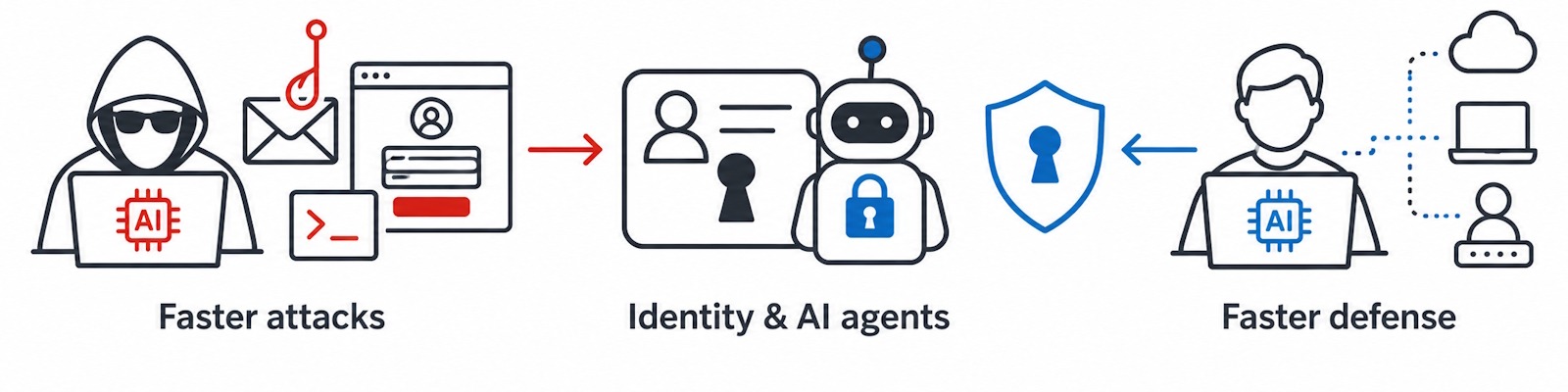
AI is the biggest story in cybersecurity today. It is not one single attack or one single breach. It is a shift in how both attackers and defenders work. Microsoft released its 2026 Digital Defense Report on October 1. The timing lines up with Cybersecurity Awareness Month. Together they have put AI at the center of the conversation.
AI Helps Both Sides
Attackers now use AI for reconnaissance. They use it to write better phishing messages. They use it to help build malware faster. Microsoft’s report notes that these AI tools mostly speed up existing attack steps. They have not yet replaced the whole attack. But speed alone matters. A faster attacker has more chances to succeed before defenders can respond.
Defenders are not standing still either. AI helps security teams find software weaknesses before attackers do. It also helps connect small clues across many systems. A single unusual login means little on its own. A pattern across endpoints, identities, and cloud systems can reveal a real attack in progress.
AI Agents Are a New Attack Surface
Organizations are adding AI agents into daily work. Each agent needs its own identity. Each agent needs limited access. Each agent needs a way to prove it is acting correctly. Each agent also needs a way to be shut off quickly if something goes wrong. Microsoft’s report treats this as a core requirement, not an optional extra. An AI agent with too much access is simply a new kind of insider risk.
Identity Is Still the Front Door
Most attacks still start with stolen credentials or a tricked user. This has not changed. AI has only made the entry point easier to reach. A phishing email now reads more naturally. A fake login page looks more convincing. The target is still a person typing a password or approving a login.
Simple Tricks Still Work
Social engineering remains effective even as AI advances. ClickFix campaigns are a clear example. A fake verification screen asks a visitor to paste a command into their own computer. The visitor believes they are solving a small problem. They are actually starting an infection. This kind of trick needs no software flaw at all. It only needs a convincing moment and a willing click.
Other Stories Worth Watching
A few other stories are drawing attention this week. The FBI reported a cybersecurity incident after attackers stole personal data belonging to its own agents. Cryptocurrency platforms had their worst month of hacks in 2026, with reported losses near 768 million dollars. Both stories reinforce the same lesson. Attackers follow whatever path is easiest, whether that path runs through a government agency, a crypto exchange, or an ordinary employee’s inbox.
The Takeaway
AI is changing the pace of cybersecurity. It is not yet changing the basic shape of most attacks. Identity theft, phishing, and simple social engineering still open most doors. The organizations that do best will treat AI as something to secure, not just something to deploy. They will also keep investing in the basics that still stop most attacks today.