
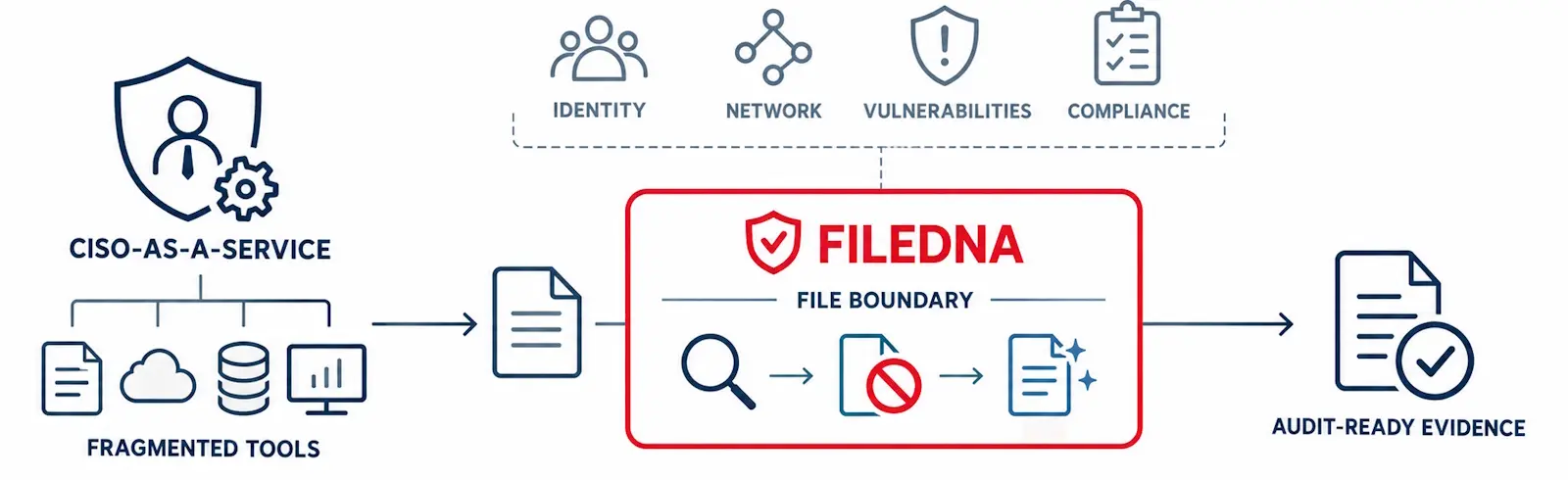
A new Sophos survey of 800 managed service providers shows that CISO-as-a-service has become the default expectation, while the tooling underneath it has not caught up. FileDNA cannot close that gap on its own, but it can close the piece of it that lives at the file boundary.
A survey of 800 managed service providers commissioned by Sophos puts a number on something most MSPs already feel in their day to day work. Customers now lean on their providers for CISO level judgment, with an average of 46 percent of an MSP’s customer base relying on the provider to fill that role. Compliance has become a large part of why. Sophos estimates that compliance requirements now influence roughly half of customers’ security purchasing decisions, which means providers are being asked not just to secure their customers but to prove it, repeatedly, against frameworks their customers did not choose and often cannot fully articulate themselves.
The survey’s most striking figure is how few providers can meet that expectation end to end. Only 6 percent of the MSPs surveyed deliver all seven compliance services Sophos asked about, and most providers cover somewhere between four and six. Even among providers who describe themselves as managing full compliance programs for their customers, only about 10 percent also deliver the other six services in the set. Scott Barlow, Sophos’s vice president and chief evangelist, framed the opportunity and the constraint in the same breath: MSPs have a chance to become indispensable strategic partners to their customers, but scaling that role requires a more unified operating model, one where security posture, compliance management, and reporting stop living in separate systems.
The reporting numbers explain why a unified model is so hard to reach today. Eighty nine percent of surveyed providers already use software tools for compliance work, so the problem is not a lack of tooling, it is fragmentation across too much of it. Fifty five percent of MSPs still generate security posture reports with a partially manual process, and only 33 percent have gotten posture reporting to a fully automated state. Confidence tracks the same pattern: 95 percent of providers say they can track compliance across their customer base, but only 33 percent say they are completely confident in that tracking. Providers who estimated the impact of a unified platform put the potential time savings at roughly 50 percent, which is a rough proxy for how much time is currently lost to manually reconciling data that different tools were never built to share.
Where FileDNA fits, and where it does not
It would be easy to read a survey about compliance reporting and claim that a file security product solves the whole picture. It does not, and that overclaim would not survive contact with the data above. Identity governance, network segmentation, vulnerability management, and the other domains that make up a full compliance program sit outside what FileDNA does. FileDNA is a Content Analysis, Disarm and Reconstruction platform, a Content Security Layer built to neutralize file based threats at the point they enter an environment, whether that is email, a web upload, a shared drive, or a partner integration. Its honest scope is the file boundary, not the entire compliance stack a CISO or an MSP acting as one is expected to manage.
Within that scope, though, the Sophos findings describe almost exactly the pattern FileDNA was built to interrupt. Most regulatory frameworks that drive compliance purchasing, including PCI DSS’s malware protection requirements, HIPAA’s Security Rule safeguards against malicious software, and NIST SP 800 53’s controls for malicious code protection, require documented, ongoing evidence that content entering an environment is being inspected and controlled. Under a conventional stack, an MSP typically assembles that evidence from several disconnected tools: an email security gateway, a sandbox or detonation service, endpoint antivirus, and sometimes a separate content disarm and reconstruction product layered on top. Each one logs differently, each one needs its own reporting pull, and each one adds to the 55 percent of MSPs still stitching posture reports together by hand.
FileDNA consolidates that specific slice of the stack into one layer. Because it disarms and reconstructs files at the point of delivery rather than relying on signature matching or reputation lookups, it produces a consistent, structured record for every file it touches, what came in, what was found, what was removed or rebuilt, and when. That record is the kind of artifact compliance frameworks ask for directly, and it is generated as a byproduct of the security control itself rather than as a separate reporting exercise bolted on afterward. For an MSP managing dozens or hundreds of customer environments, that consistency also addresses the scalability problem underneath the survey’s numbers. A single Content Security Layer deployed the same way across every tenant does not require the constant per customer signature tuning that traditional file scanning tools do, which is part of why only a third of providers have gotten anywhere close to fully automated reporting today.
A narrow fix for a wide problem, and why that is still worth having
Sophos’s data describes a 46 percent expectation gap and a 6 percent delivery reality, and no single product closes a gap that size. What FileDNA offers an MSP stepping into the CISO role is narrower and more concrete: one fewer category of disconnected tooling to reconcile by hand, and audit ready evidence for the content security controls that show up across nearly every compliance framework a customer might ask about. That is not the whole answer to the unified operating model but it is a real reduction in the manual work that keeps providers stuck at four to six services instead of seven, and it is the piece of the problem that sits closest to where files, and the threats riding inside them, actually enter the environment.
References
ComputerWeekly MSPs are becoming customers’ chief information security officers
Help Net Security MSPs are the CISO now, but their compliance stack isn’t ready
Yahho News MSPs Have Quietly Become Acting CISO for Nearly Half of Their Customers, Sophos Research Finds
Business Insider MSPs Have Quietly Become Acting CISO for Nearly Half of Their Customers, Sophos Research Finds
Sophos. MSP survey of 800 managed service providers on CISO services, compliance delivery, and security posture reporting